
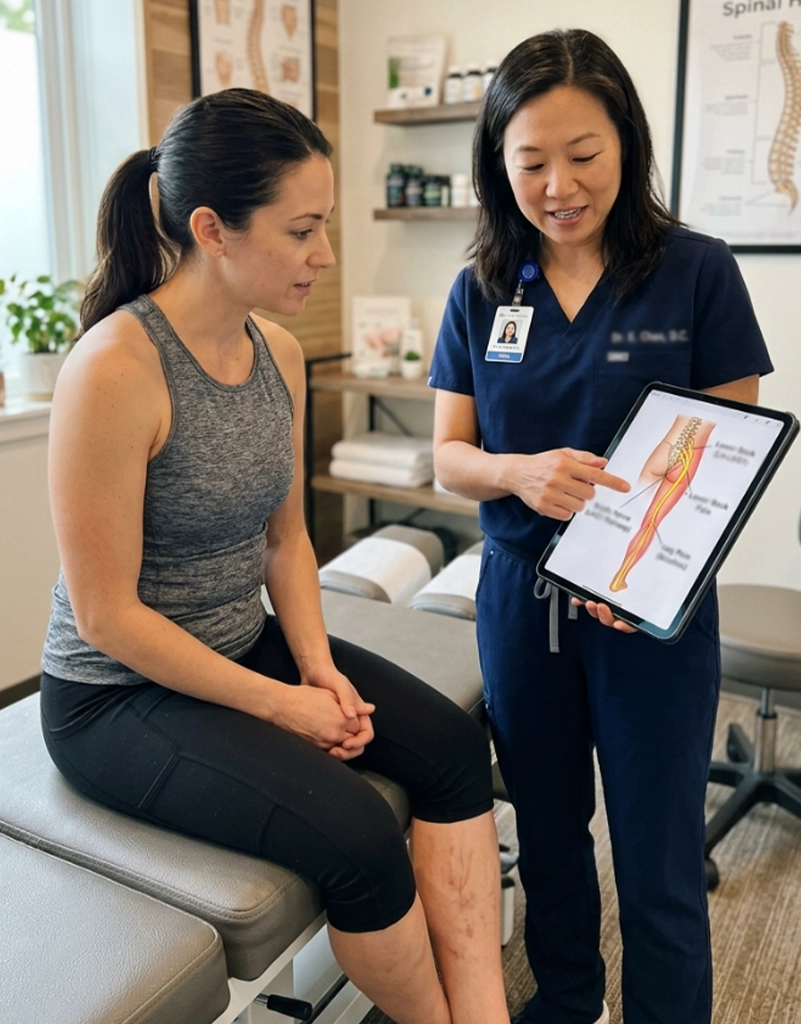
Sciatica has a way of taking over daily life. It can start as a dull ache in the lower back or hip, then turn into sharp pain, tingling, or numbness that runs down the leg. For some people, it comes and goes. For others, it keeps getting worse the longer it is ignored.
That is one reason many patients start looking into chiropractic care. They want something that addresses the source of the irritation instead of only helping them get through the day. Chiropractic care may be a helpful option for certain types of sciatic pain, especially when the issue is connected to spinal movement, joint restriction, or pressure patterns through the lower back and pelvis.
What Sciatica Actually is
Sciatica is not a condition by itself as much as it is a symptom pattern. It happens when the sciatic nerve becomes irritated or compressed. That nerve runs from the lower back through the hips and down each leg, which is why the pain often travels.
Some people feel burning or shooting pain. Others notice tingling, weakness, or numbness. The symptoms may stay mostly in the hip and buttock, or they may move all the way down the leg.
Common Reasons Sciatica Starts
Sciatic pain can come from a few different sources. In many cases, the issue begins in the lower back. Restricted joints, disc irritation, muscular tension, and pelvic imbalance can all add stress to the nerve pathway.
It may also build over time from posture habits, prolonged sitting, repetitive bending, or movement patterns that keep the lower body under constant strain. That is why sciatica does not always begin with one obvious injury.
How Chiropractic Care May Help

Chiropractic care for sciatica focuses on how the spine, pelvis, and surrounding joints are moving. When those areas are not functioning well, the body often compensates in ways that increase tension and irritation around the nerve.
A chiropractor may evaluate spinal alignment, joint motion, muscle tension, posture, and the way your symptoms travel. From there, treatment is designed to improve mobility, reduce mechanical stress, and help the body move with less strain.
Chiropractic care may help by:
- improving movement in the lower back and pelvis
- reducing joint restriction that may be adding stress to the area
- easing muscular tension that contributes to compression
- supporting better posture and movement patterns
- helping patients move more comfortably through daily activity
Signs You Should Not Ignore
Sciatica does not always stay mild. If the pain is becoming more frequent, traveling farther down the leg, or making walking, standing, or sleeping harder, it is worth getting evaluated.
It is also smart to stop waiting it out if symptoms are starting to affect your routine. A problem that begins as occasional irritation can become harder to manage when compensation patterns settle in.
Small Daily Habits that Can Make it Worse
Long periods of sitting are a common trigger. So is lifting with poor mechanics, twisting under load, and trying to stretch aggressively without knowing what is actually causing the pain.
Even simple habits like always shifting weight onto one side, sitting in the same position for hours, or pushing through pain during workouts can keep the cycle going.
When Chiropractic Care Makes Sense
Chiropractic care may be worth considering if sciatic pain keeps returning, feels tied to the lower back or hips, or is limiting normal movement. The goal is not just to chase the pain down the leg. It is to look at why the area is under stress in the first place.
A proper evaluation matters because not every case of sciatica is the same. That is part of why personalized care is so important.
Final Thoughts
Sciatica can start small and become a much bigger problem if the underlying issue is never addressed. Chiropractic care may help reduce stress on the lower back and pelvis, improve movement, and support better day-to-day comfort.
If your sciatic pain is getting harder to ignore, it may be time to find out what is really driving it.