

Not all chiropractic care looks the same. If you’ve ever searched upper cervical vs traditional chiropractic, you probably noticed a lot of vague answers and confusing jargon. You deserve better than that.
Both approaches share the same foundation: your body heals best when your spine is properly aligned and your nervous system works without interference.
The difference comes down to where the chiropractor focuses, how the adjustment is delivered, and which conditions respond to each method. Let’s break it all down in plain language.
Key Takeaways
- Traditional chiropractic works on your full spine. Upper cervical chiropractic targets only the top two bones in your neck.
- Techniques like NUCCA, Blair, and Atlas Orthogonal use low-force corrections guided by advanced imaging, not the cracking or popping of most people’s pictures.
- Migraines, vertigo, and nerve interference often respond well to upper cervical care. Back pain, sciatica, and sports injuries are strengths of general chiropractic.
- Functional Chiropractic in Huntsville, Alabama offers both approaches so your care plan fits your body, not the other way around.
What Is Traditional Chiropractic Care?

Traditional chiropractic, sometimes called general or full-spine chiropractic, focuses on the entire spinal column. Your chiropractor looks for subluxations, which are misalignments that restrict movement and put pressure on nearby nerves.
The goal of every chiropractic adjustment is to restore proper spinal alignment so your body can function the way it’s designed to.
Several well-known techniques fall under this category. The Diversified technique is the classic hands-on adjustment that often produces an audible pop. Gonstead pairs specific manual adjustments with detailed X-ray analysis.
The Activator Method uses a small spring-loaded instrument for lighter corrections. Thompson Drop relies on a segmented table that gives way during the thrust, reducing the force your body absorbs.
This type of care works well for low back pain, mid-back stiffness, sciatica, sports injuries, and general joint restrictions.
A typical visit includes a posture check, range-of-motion testing, and hands-on adjustments to several spinal segments. Most patients start with two to three visits per week and taper down as they improve.
What Is Upper Cervical Chiropractic?
Upper cervical chiropractic is a specialized branch that zeros in on the top two vertebrae in your neck: the atlas (C1) and the axis (C2). These bones are unlike any other segment in your spine. They have no intervertebral disc between them.
They allow your head to nod, tilt, and rotate. That freedom of movement also makes them the most vulnerable spot for misalignment.
Here’s why that matters. Your brainstem passes directly through the ring of C1. It controls heart rate, breathing, sleep cycles, digestion, and balance.
When the atlas or axis shifts even slightly, it can create nerve interference, disrupting the signals that travel between your brain and the rest of your body.
That’s why a small misalignment at the top of the neck can trigger symptoms that seem completely unrelated: chronic migraines, dizziness, brain fog, jaw pain, and fatigue.
Upper cervical care corrects this specific region using gentle, precise methods instead of broad manual force.
Upper Cervical Chiropractic Techniques
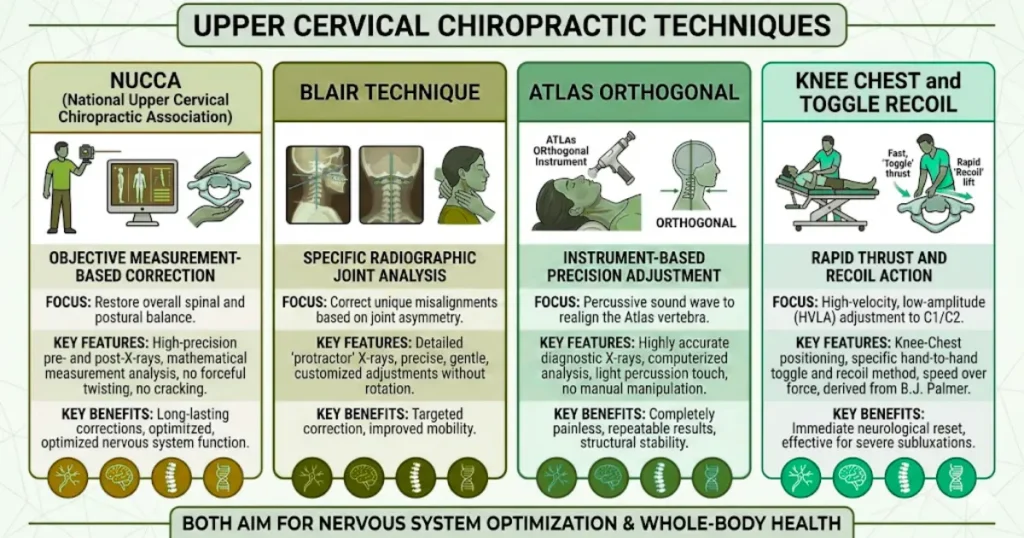
Most people have never heard these names, but they represent decades of research and refinement. Each uses a different analysis and correction style, yet all share the same goal: restore alignment at C1 and C2 with minimal force.
NUCCA (National Upper Cervical Chiropractic Association)
NUCCA uses precise X-ray measurements to calculate the exact angle of your atlas misalignment. The correction is a sustained, light pressure applied by hand just below the ear. There’s no twisting, cracking, or popping involved. This method is known for mathematical precision and its focus on restoring whole-body postural balance.
Blair Technique
Developed by Dr. William Blair, this technique uses specialized imaging, including CBCT (Cone Beam CT) scans, to map the unique shape of each patient’s atlas joint. Because no two spines are identical, every correction is customized. The adjustment is a quick, gentle contact in the side-lying position.
Atlas Orthogonal
Atlas Orthogonal uses a table-mounted percussion instrument that sends a precise, sound-wave-like impulse to the atlas. Patients barely feel the correction. Detailed X-ray analysis guides every adjustment to ensure accuracy.
Knee Chest and Toggle Recoil
This is the original upper cervical method, developed by B.J. Palmer in the 1930s. The patient kneels on a specially designed table. The chiropractor delivers a quick, shallow thrust and immediately withdraws the hands. It’s light force, high speed, and zero rotation.
Why Stress and Tension Can Add to the Problem
Stress does not cause asthma by itself, but it can change the way people breathe. Many people respond to stress by breathing more shallowly and holding more tension through the neck, shoulders, and chest.
When that becomes a habit, the body may feel tighter and more restricted overall. This is one reason some patients feel that their breathing comfort changes depending on posture, stress level, and daily physical tension.
Key Differences Between Upper Cervical and Traditional Chiropractic
The table below gives you a quick side-by-side snapshot. Keep reading for more context on each point.
| Factor | Traditional Chiropractic | Upper Cervical Chiropractic |
|---|---|---|
| Focus Area | Full spine and joints | C1 and C2 vertebrae only |
| Force Level | Moderate to firm thrust | Gentle, low-force correction |
| Adjustment Style | Audible pop or crack is common | No cracking, twisting, or popping |
| Diagnostic Tools | Posture assessment, basic X-ray | CBCT scans, thermography, precision X-rays, leg length analysis |
| Visit Frequency | 2–3x per week initially | Less frequent; adjustments designed to hold longer |
| Best For | Back pain, sciatica, sports injuries, stiffness | Migraines, vertigo, TMJ, post-concussion, nerve-related issues |
The biggest practical difference patients notice is the level of force. Upper cervical corrections are so gentle that many people wonder if anything actually happened. Traditional adjustments involve broader contact across multiple spinal segments and are more hands-on by nature.
Another key distinction is how progress gets measured. Upper cervical practitioners use objective post-adjustment testing, including paraspinal thermography and leg length checks, to confirm each correction is holding. If your body is stable at a follow-up visit, you don’t get adjusted. That’s actually a sign of progress, not a wasted appointment.
Which Conditions Respond Best to Each Approach?
Upper cervical chiropractic tends to help most with conditions linked to nerve interference at the brainstem level: chronic migraines, vertigo and dizziness, TMJ disorders, post-concussion symptoms, trigeminal neuralgia, and certain types of dysautonomia.
Traditional chiropractic is often the better starting point for low back pain, mid-back stiffness, sciatica, muscle spasms, sports injuries, and general postural problems.
Both approaches can help with tension headaches, neck discomfort, disc-related issues, and overall wellness. The right fit depends on where the root cause lives in your spine, which is why a thorough evaluation matters before settling on a care plan.
What to Expect at Your First Visit
First Visit With a Traditional Chiropractor
Expect a health history review, posture assessment, and range-of-motion testing. Some offices take X-rays on the first day. Your chiropractor will perform a chiropractic adjustment to multiple spinal areas, sometimes combined with soft tissue work. You may hear popping sounds during the session. Plan for 30 to 45 minutes.
First Visit With an Upper Cervical Chiropractor
This appointment usually runs longer, around 45 to 60 minutes, because of the detailed analysis involved. You’ll complete a health history focused on head and neck trauma.
The doctor takes precision imaging (CBCT or upper cervical X-ray series) along with a paraspinal thermography scan to measure nervous system stress. If a misalignment is confirmed, a gentle correction is made. You’ll rest afterward to let the adjustment settle before heading home.
Can You Combine Both Approaches?
Absolutely. Many patients benefit from receiving upper cervical correction for a condition like chronic migraines while also getting traditional care for a stiff lower back. The key is sequence. When the top of the spine is corrected first, the segments below often respond better to additional treatment.
Functional Chiropractic in Huntsville, Alabama offers both upper cervical and full-spine care under one roof. Your treatment plan is built around your body and your goals, not limited by a single technique. Call (256) 714-6166 to learn which approach fits your situation.
Upper Cervical vs. Traditional Chiropractic: Find the Right Fit for Your Body
he choice between upper cervical vs traditional chiropractic comes down to your symptoms, the root cause of your problem, and what feels right for you.
Both methods support your body’s natural ability to heal by restoring spinal alignment and reducing nerve interference. They’re not competing philosophies. They’re complementary tools. Functional Chiropractic in Huntsville, Alabama is here to help you figure out which approach, or which combination, gives you the best path forward. Call your trusted chiropractor in Huntsville today at (256) 714-6166 to schedule your first visit.
Frequently Asked Questions
Can a regular chiropractor do upper cervical adjustments?
Most general chiropractors focus on full-spine care and don’t specialize in upper cervical methods. Techniques like NUCCA, Blair, and Atlas Orthogonal require advanced post-graduate training and precision imaging. If you need upper cervical care, look for a doctor with specific certification in one of these approaches.
Is NUCCA better than regular chiropractic?
NUCCA isn’t better across the board. It’s a specialized method that works best for conditions tied to upper cervical misalignment and nerve interference, like migraines and vertigo. Traditional chiropractic is often more effective for general musculoskeletal pain. The best choice depends on your specific condition.
What does upper cervical misalignment feel like?
Symptoms vary widely. Common signs include chronic headaches, neck stiffness, dizziness, jaw pain, brain fog, fatigue, and uneven posture. Some patients feel discomfort directly in the neck. Others notice problems far from the spine because interference at C1 or C2 can affect the entire body through the brainstem.
What is the difference between NUCCA and Blair chiropractic?
Both target the atlas (C1) vertebra. NUCCA relies on calculated X-ray measurements and a sustained hand pressure to level the head and neck. Blair uses 3D imaging to map each patient’s unique joint anatomy and delivers a quick, light correction based on that individual structure. Different analysis methods, same end goal.