
Blair Upper Cervical Technique in Huntsville, AL
Measured first, then adjusted
The Blair Technique is an upper cervical method built around an inconvenient fact about human necks: the joint surfaces at the top of your spine are not symmetrical, and they are not shaped like anyone else's. Standard imaging angles cannot show those joints squarely, which means a misalignment can be missed or invented depending on how the film was taken. Blair solves that by measuring your anatomy first and then taking images at angles built specifically for you. Dr. Porter has worked in upper cervical care since 2009 and uses Blair alongside Toggle Recoil at the Huntsville office.
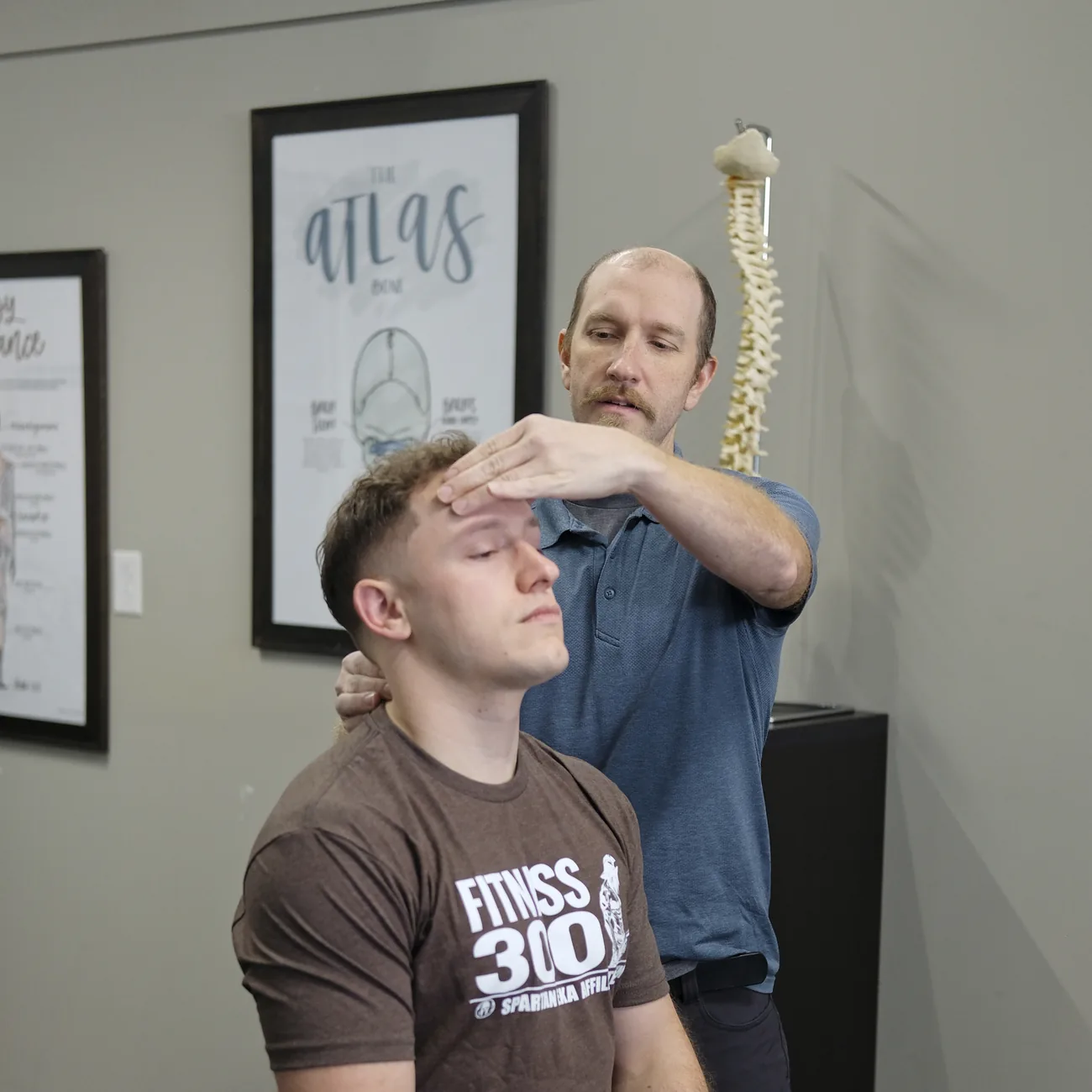
Understanding the Blair Technique
The atlas (C1) sits directly beneath the skull and carries its weight on two small joint surfaces. Those surfaces are angled, and here is the part that matters: the angle on your left is usually not the same as the angle on your right, and neither one matches the person sitting beside you in the waiting room. A single standard neck X-ray shoots through both joints at whatever angle the machine happens to be set to, which means what you see is a shadow of a joint viewed sideways rather than the joint itself.
Dr. William G. Blair worked this out in the 1950s and built a method around it. Before any images are taken, the skull and neck are measured. Those measurements determine the angles for each view, so the beam travels parallel to the actual joint surface rather than across it. What comes back is a picture of whether that specific joint is misaligned, and by how much, and in which direction, instead of an educated guess.
The correction that follows is light. Because the analysis has already established the exact vector, the adjustment does not need force to work, and there is no rotation or twisting of the neck at any point. Most patients are surprised by how little happens. The work was done in the measuring.
There is a second consequence that surprises people more. Because care is built around whether the correction is holding, you are checked at each visit and adjusted only when the check shows you have lost it. On a good stretch that can mean several visits in a row where Dr. Porter examines you, tells you the correction is holding, and sends you home without touching your neck.
How we approach blair technique care
- Your anatomy is measured before any imaging is taken, so the views are built around your joint angles rather than a standard setting.
- Analysis establishes the direction and degree of misalignment, which determines the vector of the correction.
- The adjustment itself is low-force and specific, with no rotation, twisting, or cavitation of the neck.
- Post-correction checks confirm the change rather than assuming it.
- At every subsequent visit you are checked first. If the correction is holding, you are not adjusted.
Signs the Blair approach may fit you
- Headaches or migraines that begin at the base of the skull
- Dizziness, vertigo, or a sense that your balance is slightly off
- Symptoms that started after a car accident, a fall, or a sports impact
- Jaw tension or facial pain that dental care has not resolved
- Long-standing neck problems that general adjusting has not held
- A strong preference for care with no twisting or popping involved
What your visit includes
- A consultation and full neurological, orthopedic, and postural examination
- Measurement of your upper cervical anatomy to set the imaging angles
- A Blair Analysis X-ray series taken at those angles
- A report of findings visit where Dr. Porter walks you through the images
- The specific correction, plus a re-check to confirm it

What to expect on your first visit
Your first visit is a conversation and an examination, and no adjustment happens at the end of it. Dr. Porter wants your history, what set this off, what you have already tried, and what you actually want back. From there he examines you and takes the measurements that determine your imaging angles. Sending you home unadjusted on day one is deliberate. A Blair correction depends on knowing the direction before delivering it, and nobody knows that yet.
You come back for the report of findings. Dr. Porter puts your images up, shows you what he found, explains what it means in plain language, and tells you whether this is the right approach for your situation. If it is, your first correction happens at that visit. If it is not, you will hear that instead, and he will point you toward whatever fits better.
Blair Technique questions, answered
What would you like to do next?
Pick the option that sounds most like you, we’ll point you to the right next step.
I'm in pain and want to start
Book a first visit or call us, same-day appointments are often available.
Book an appointmentI'm still researching
See how approaches compare and what to check before you call.
Browse resourcesI'm checking pricing & logistics
See our hours and location, and get simple, up-front self-pay pricing.
Get in touchI want to see the office first
Walk the clinic before you book, from the front door to the adjusting floor.
Take the office tourReady to feel and function like yourself again?
Call or book online, same-day appointments are often available.
8400 Memorial Pkwy SW, Huntsville, AL 35802 · (256) 714-6166