
Written and medically reviewed by Dr. R. S. Porter, D.C. · Doctor of Chiropractic · Last reviewed 2026
The conversation comes before the examination
The first visit opens with history, and with POTS in the picture it takes longer than usual. Dr. Porter wants the timeline in detail. When symptoms started, what was happening in the weeks before, what the first symptom was, and how the pattern has changed since.
He will ask what your medical workup has already established. Which physicians you have seen, what testing was done, what was ruled out, what you were diagnosed with and when, and what medications you are taking. Bring the actual records if you have them. Guessing at what a tilt table study showed is not useful to either of us.
He will also ask about injuries you have stopped mentioning because you assume they are unrelated. The fall off a horse in high school, the concussion from a wreck years before the symptoms started, the surgery where your neck was positioned oddly for four hours.
The examination itself
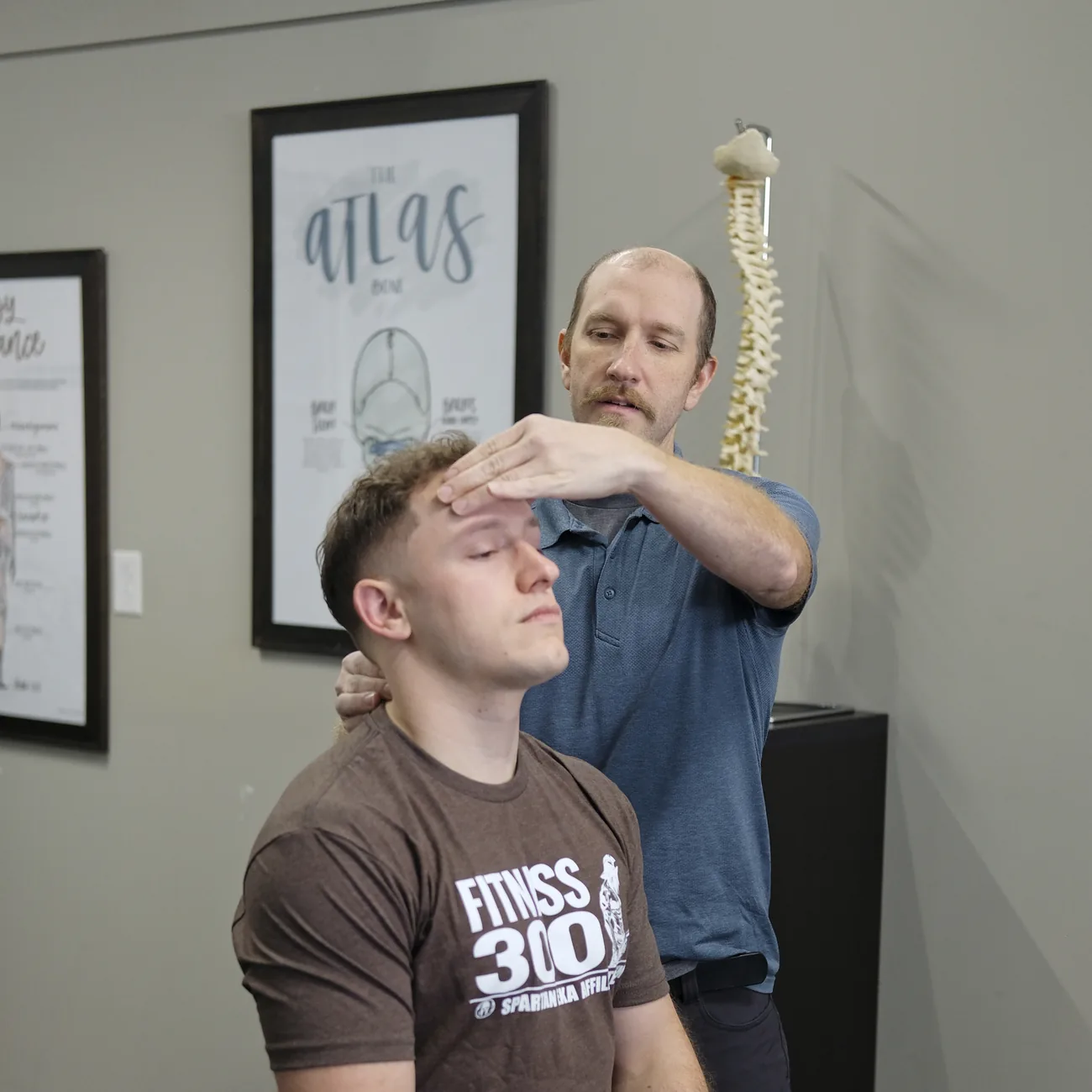
The physical examination is focused on the upper neck and on how your head sits on it. He measures head position rather than eyeballing it, assesses how the atlas and axis move, and checks the surrounding muscles for the compensation patterns that show up when a joint is not holding position.
Range of motion is tested cautiously, and more cautiously still if hypermobility is in your history. A basic neurological screen is part of it, looking for the signs listed in part four that would redirect you to a physician instead.
Because standing and position changes are the problem in POTS, the examination is paced around that. You are not left standing while someone writes notes, and if a position makes you symptomatic, say so and it stops.
When imaging is used, and when it is not
Blair technique relies on imaging taken at angles specific to your anatomy rather than standard views, because the joint surfaces at the top of the neck vary considerably between people. The point is to see how your joints are actually built before deciding anything about them.
If imaging is not needed, it is not done. If you have recent cervical imaging from another provider, bring it, because it may be sufficient and there is no reason to repeat radiation you have already had.
The findings that would support trying care
A reasonable case for an attempt looks like several of these lining up rather than any one of them alone:
- a documented head or neck injury in the right timeframe relative to symptom onset
- symptoms that change reproducibly with head position
- examination findings at the atlas or axis consistent with the side and pattern of your symptoms
- imaging that shows a position relationship worth correcting
- a medical workup already underway or complete, with physicians you are in contact with
The findings that would end it there
Several things would lead Dr. Porter to recommend against care at the first visit:
- no injury history, no position dependence, and an unremarkable upper cervical examination
- any sign suggesting craniocervical instability or a neurological problem needing medical evaluation
- a medical workup that has not happened yet, in which case that comes first
- an expectation on your part that this will resolve your POTS, which he is not able to deliver
Why there is no adjustment on day one
This practice does not adjust on the first visit. Imaging has to be reviewed and the analysis has to be done before anyone decides what, if anything, to correct, and that is more true with a complicated autonomic history than with a straightforward neck complaint.
If care does begin, the measure of whether it is working is not how you feel in the twenty minutes after an adjustment. It is whether the correction holds between visits, which is a different and more useful question.
Cost, coordination, and the honest ceiling
Functional Chiropractic is a cash, self-pay practice and does not bill insurance. For a patient already carrying the cost of a chronic condition that is a real consideration, and it is better to know it before you arrive than after.
Dr. Porter will communicate with your physicians and would rather be one coordinated part of a plan than a parallel track nobody is comparing notes on. He will also tell you plainly if he does not think he can help, which happens often enough with POTS inquiries that you should expect it as a genuine possible outcome of the visit rather than a formality.