
Written and medically reviewed by Dr. R. S. Porter, D.C. · Doctor of Chiropractic · Last reviewed 2026
The overlap between POTS and loose joints
A substantial share of POTS patients are also hypermobile. The usual label is hypermobile Ehlers-Danlos syndrome (hEDS) or hypermobility spectrum disorder, both of which describe connective tissue that is more elastic than average. Joints move past normal range, skin may be soft or stretchy, and sprains and subluxations come easily.
Hypermobility, POTS, and mast cell activation problems cluster together often enough that many clinicians look for the other two whenever one shows up. Nobody has established a single cause for the cluster. The practical consequence is what matters here.
Why that changes the chiropractic question entirely
Most chiropractic care exists to restore movement to a joint that has lost it. That is the whole premise of an adjustment, and for the majority of patients it is a sound one.
A hypermobile upper neck has the opposite problem. The joint is not stuck. It has more movement than it can control, and the surrounding muscles are working overtime to compensate for ligaments that do not hold position well. Adding range to a joint that already has too much is not a neutral act.
This is the single most important thing for a hypermobile POTS patient to understand before booking with anyone. The forceful rotary adjustment of the neck, the one with the twist and the audible pop, is the wrong tool for this presentation. It may feel good briefly, because stretching an irritated area often does, and it can leave the joint less stable than it was.
What low-force upper cervical care actually means
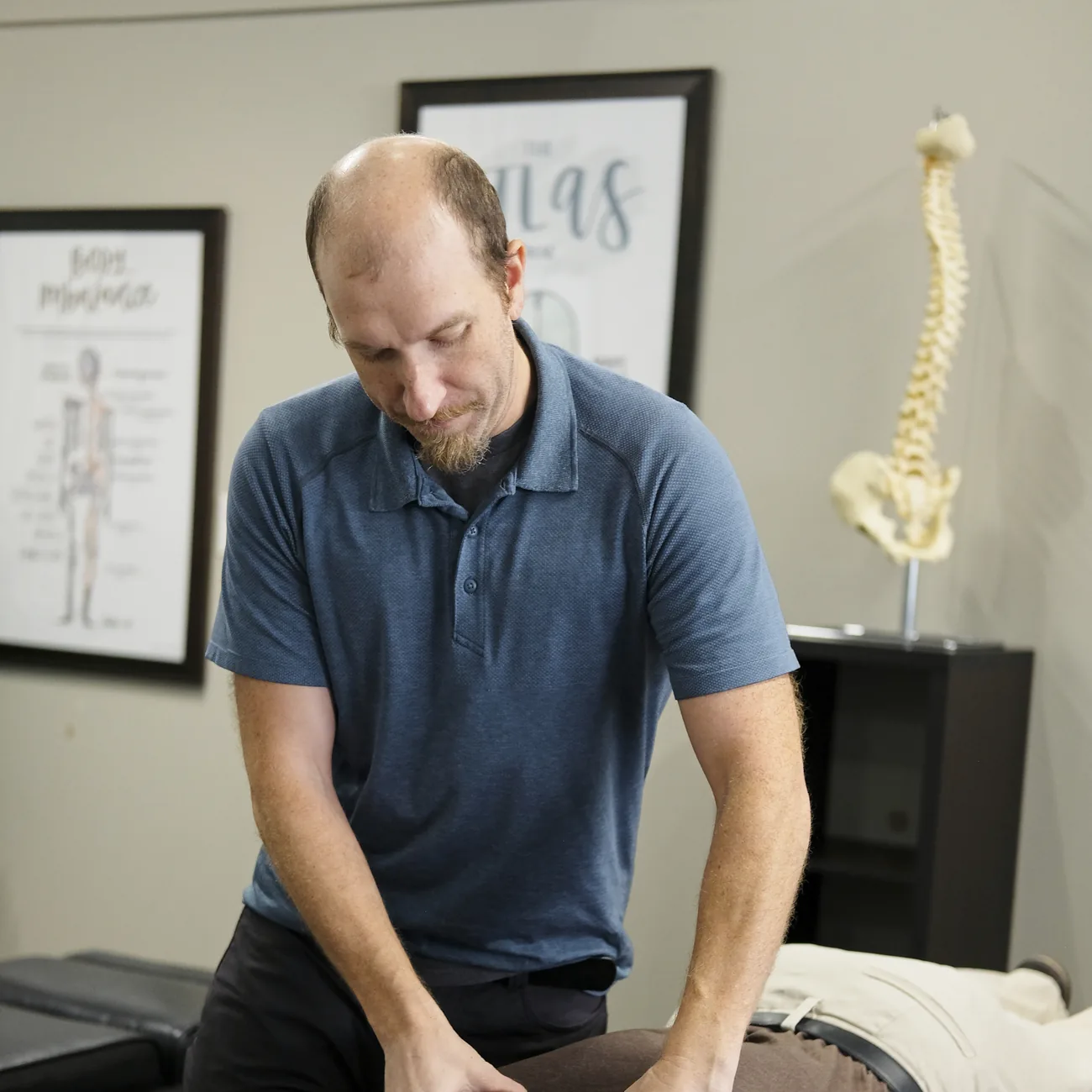
Dr. Porter uses Blair and Toggle Recoil, both of which are specific, measured, low-force techniques. There is no twisting of the head and no cavitation, which is the medical name for the pop. The contact is light and directed, chosen from imaging and examination rather than from where the neck feels tight under the hand.
The goal with a hypermobile patient is also different. It is not to create more movement. It is to improve the position relationship at the atlas and axis with the smallest input that will do it, then leave it alone long enough to see whether the surrounding tissue settles.
That often means fewer visits and fewer adjustments than a hypermobile patient expects, not more. If a joint holds its correction, adjusting it again is working against yourself.
When chiropractic is not the right call at all
Some presentations need medical and sometimes neurosurgical evaluation rather than any form of adjusting. Craniocervical instability, where the ligaments holding the skull to the top of the spine are insufficient to do the job, is a recognized concern in connective tissue disorders and is not something to manage with chiropractic care.
Take these to a physician rather than to a chiropractic office:
- a heavy, dragging sensation at the base of the skull that is relieved by holding your own head up
- new or worsening numbness, weakness, or coordination problems in the arms or legs
- difficulty swallowing or changes to your voice
- severe headache at the base of the skull that changes sharply with head position
- vision changes, double vision, or new problems with eye movement
- fainting outright rather than feeling close to it
That list is not meant to frighten you
Most hypermobile POTS patients do not have craniocervical instability, and the symptoms above have other explanations more often than not. The reason to publish the list is that a patient who is told to expect exactly this kind of finding, by someone who then offers to treat it with adjustments, is in a bad position.
If Dr. Porter sees anything on that list in your history or examination, the recommendation is imaging and a referral, not a care plan.
How to vet any chiropractor for this
These questions are worth asking whoever you see, here or anywhere else. The answers tell you a great deal quickly:
- Will you examine and image my upper neck before you adjust it, or on the first visit?
- What force do you use, and does your technique involve twisting the head?
- Do you know what hypermobility changes about your approach, and what do you change?
- Will you tell me if you do not think you can help, and will you put that in writing to my physician?
- What would make you stop care rather than continue it?
What this does not promise
Choosing a gentler technique lowers the risk of making a hypermobile neck worse. It does not establish that the care will improve your POTS, and nothing in this article should be read that way. The evidence situation described in part two has not changed.
What it means is narrower and still worth something. If you are going to explore this avenue, the force selection is not a preference or a marketing angle. For a hypermobile patient it is the difference between a reasonable thing to try and a bad idea.